20120206

Deepavali (BH:D84)


October 26, 2011

Snuggling under a blanket on a cool morning as the night rain continues into the dawn; the raindrops meeting the saturated soil in a million resonating kisses. I presume all heavenly afterlives of bliss include this.

The festival of lights was distinctly devoid of fireworks for the past decade in my life. American fireworks are restricted to July 4th. So it was wonderful to have unrestrained sound, light and fury of Sivakasi imports right outside the house yesterday night. Wispy smoke floated through the house. The smell of sulphur, gunpowder and danger! The kids in the neighborhood enjoyed hand-held sparklers and spinning discs that shoot rainbow sparks all over the place. The entire periodic table of elements must be inside them creating such a dazzling display. Neighborhood dogs were not so pleased. Neighborhood cats were in hiding. 

The booms, loud and muffled, and whistles and fizzles went on late into the night. A bunch of adults who had alcoholically shaved off a few years of maturity from their lives were stationed in one of the house terraces. Regular launches from their arsenal. Peonies, dahlias, and chrysanthemums bloomed against the night sky. Some impressive spiders too. I had no idea about that these fireworks effects had standard names till I looked up wikipedia. 

Read the episode of Yayati, his wives, Devayani and Sharmistha, and their background stories in the Mahabharatha today. Before marrying Yayati, Devayani was in love with Kacha. Brihaspati is the guru of the Devas while Shukra fills that post for the Asuras. Shukra knows the Mritasanjeevani mantra that can bring back the dead. Using it, he manages to revive the Asura army everytime they are trounced by the Devas. The dead among the Devas are done for good because Brahaspati doesn't know the elixir mantra. Clearly unacceptable! After consultation with Indra, the king of the Devas, Brihaspati sends his son, Kacha, to Shukra to become his disciple and learn the life-giving mantra for the Devas. Indra tells him that the easy route would be through Devayani. 

For 500 years, Kacha remains a humble, faithful disciple. Like a Bollywood hero, he carves a niche in the heart of Devayani by his "sweet words, great songs and dancing"! The Asuras recognize his true purpose. They kill him, quarter his body and feed it to the jackals. Devayani begs her dad to bring Kacha back. The sage recites the mantra. The pieces of Kacha's flesh come flying out of the jackals' stomachs and reunite to form Kacha. This would make such a spectacular FX scene. 

Again, the Asuras kill him, dismember the body and throw it into the sea. Shukra brings him back. Third time, Asuras plan better. They powder Kacha's body, mix it with alcohol and offer it to Shukra who drinks it happily without knowing. This time on reciting the mantra, he realizes that Kacha is reborn inside his own stomach. He curses alcohol. If Kacha is to live, he must die. Devayani says she will commit suicide if either of them dies. Shukra has no option but to teach Kacha the Mritunjaya mantra so that he can revive Shukra who will die as Kacha comes out of his stomach. Kacha learns the mantra and comes out. Disemboweled, Shukra dies. But using the mantra, Kacha revives him. Great scope for more special effects! 

The episode doesn't end happily for Devayani because Kacha refuses to marry her. He needs to return to the heaven. She curses him. He glumly tells her that any curse that is born out of lust is ineffective!

In the afternoon, there was a wonderful show on Doordarshan Malayalam featuring old drama songs by the O.N.V Kurup-Devarajan team. The All India Radio and Doordarshan singers recreated the evergreen songs originally sung by the likes of K.S.George, C.O.Anto, Jikki and K. Sulochana.

Talking of Devarajan, a new "tradition" at the Sabarimala temple since the early 80s is the ritualistic playing of the devotional/film song, "Harivarasanam" sung by Yesudas in Devarajan's music. The song is played late at night before the temple closes. Apparently, it is Lord Ayappan's favorite lullaby. It must be played from a CD over the loud speaker system for him to go to sleep every night. 

Devarajan, a communist and an atheist, is pretty amused by this development. While acknowleding the positive communal harmony factor involved in the fact that the song is sung by a Christian and the contract for the speaker system is held by a Christian, Kalakaumudi magazine, nevertheless, had a blistering article on the shame of such meaningless, low quality lyrics rising up to, literally, mythological stardom. There are only two words in the whole song that refer specifically to Ayyappan. The bulk is mostly generic stuff that can be applied to any Indian god. There are grammatical errors and word inventions that even a minor Malayalam poet can spot. This probably explains why nobody has come forward to claim the authorship. Even more hilariously, the lines talk about Ayyappan being tired of continous dancing when clearly the idol is seated in a yogic posture all the time and there is no prior mythology about the dancing tendencies of the god. This origin and popularization of a tradition within our lifetime makes one wonder how the various other traditions related to the hundreds of thousands of temples and gods in India must have come up. 

Called my youngest uncle to wish him on Diwali. He was nursing a lump on his forehead. "Pazhaya pole dhyram onnum illa" (I am not as bold as I used to be) he explained. He had tried to light a cracker yesterday from close vicinity and turned away in the last moment without noticing the wall next to him. Swelling. Small cut. Blood. 

Man-made crackers compete with rumbling thunder in the evening.

Shakuntala 0.0 (BH:D83)


October 25, 2011

Power went down by 9am. Achan was reading Adhyatmaramayanam loudly upstairs. I had assumed that the grand old neighbor man had tuned into All India Radio which was having some Diwali devotional special. Coming out of the house, we noticed a fallen coconut frond stuck on the telephone cables running between the posts outside doctor uncle's house. Suddenly a billhook secured with rope to a long pole thrust itself towards the defoliated tree. A khaki-clad KSEB (Kerala State Electricity Board) worker was the motive force behind the pole. Overhanging branches and leaves were being dispatched on a war footing before the rainy season picked up momentum. 

After shaving away a quarter of the gloriously green head of the coconut tree, the grim trimmer moved onto the Rambuntan tree in the vicinity. He wasn't alone. There was a supervisor wearing a white hard-hat. The one being supervised relied on the safety of his natural crown of well-oiled, thick black hair combed tightly backwards. 

Couple of the cut small branches of the Rabuntan were left hanging on the telephone and tv cables. Those wires are not the KSEB's department. Their concern stops at the power lines that run much higher up. I don't think KSEB pays gravity for its services. It is high time electricity and gravity formed a union! 

The precautionary botanical butchering that continued far up the street gently swayed the cables outside the house intermittently.
Since power was not going to return till the de-branching operation was complete in the colony, I decided to get back to some offline reading. The Shankunthalam episode in Kunjikuttan Thampuran's Mahabharatham. 
What a delight! 
I was only familiar with the Kalidasa version of the myth which formed the basis of numerous movies. Reading the original makes one stand up and applaud the genius of Kalidasa who refurbished this tale into one of romance, suspense, repentance and reunion. There is no disturbing bumble bee, no mudra ring, no heartbreak in a boat and no fish swallowing the ring in the original. The fishy birth of Matsyagandha appears in the epic immediately before the Shakuntala episode. It is pretty clear that Kalidasa borrowed from that story to add masala to his Shankuntalam.

Talking of masala, the infamous "pallu-drop", by vamps of yesteryears and heroines more recently, is an common fixture of any formulaic commercial Indian movie. The original inspiration is in the Menaka-Vishwamitra story of the epic. Vyasa did not make Menaka drop just her pallu. He went all out for a full 'chela' (dress) drop from the hip. And while bending down to gather the fabric all back up, Menaka casts a seductive look at medidating muni. That was the end of his penance.

In the Mahabharatha version of Shakunthalam, King Dushyantha, in the middle of a rather environmentally destructive hunting expedition, walks right into sage Kanva's ashram looking for sage Kashyapa. Much confusion. May be Kashyapa and Kanva were roomies. May be they had a time sharing arrangement about the magnificient (as described in detail) hermitic resort on the banks of river Malini. 
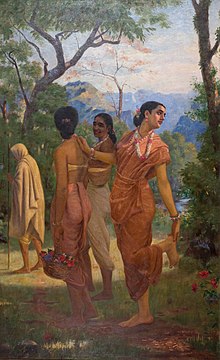
There is no bumble bee disturbing Shankuntala, like it did M.S.Subbalakshmi, K.R.Vijaya and numerous other Indian heroines, from which she needs saving. Neither does she strike the classic Ravi Varma pose, turning backwards with her left feet raised, trying to glance at Dushyantha again while pretending to remove a thorn from her heel. 

In the Vyasa version, she comes out of the ashram, introduces herself and sweeps Dushyantha off his feet. But before he does anything about that sweep, he must find out how a sworn celibate ascetic like Kanva ended up having a daughter. She explains in rather graphic detail her mother Menaka's escapade with Vishwamitra. Before going to dance before Vishwamitra as demanded by Indra, Menaka asks Indra to send a fragrant breeze with her which could gently shift her clothes as she dances. The iconic Marlyn Manroe photograph comes to mind.

As soon as Dushyantha realizes that Shankuntala is also a Kshatriya product, he proposes marriage by the "Gandharva" way....which is sort of like a third date. Shankuntala doesn't ask him to come upstairs for coffee. Instead she demands that he make their son the next king. She was pretty sure it was going to be a son. She was that good. Dushyantha was in a state of mind in which he would have agreed to an eight-way split of the empire if she became an Octomom.

Gandharva-rule marriage happens. Dushyantha promptly goes back to his palace without waiting to face Kanva. Kanva comes home and realizes what has happened. He gives a rather postmodernist nod to the union. Bharatha is born and grows up into a smart boy. Shankuntala is content as a single mom. But Kanva insists that she take the prince to the palace.

She obeys. In the court, King Dushyantha refuses to recognize her and the son. She goes mad and delivers some stunning lines in front of the courtiers in a magnificent speech which foreshadows the Draupadi speech that comes later. This fiercely independent, assertive Shankuntala is nothing like the faint-hearted, coy, oh-so-delicate Shankuntala of Kalidasa. I guess by Kalidasa's time, India had already moved women from their rightful, equal standing to the tv-serial stereotyping that continues to this day. 

Here's my translation of a few of the original Shankuntala's lines: "Wife is the wealth of a man. She is his half. She is the relative of the man who desires a good life. She is the friend of the lonely man. When she advises him, she becomes his father. When she consoles him, she becomes his mother...................Look at the ants, even they take so much care of their eggs. You refuse to recognize your own son. Is there any pleasure greater than the embrace of a child, covered in dust after having played in the river?" 

In an attempt to jog his memory, she narrates her story of her birth again.
But her powerful, earnest entreaties are met with the harshest and timeless response from Dushyanta. I am translating here in full because it is dramatic perfection:
"Shankuntale, I don't remember giving you a child. It is natural for women to lie. Nobody minds that. Your mother is a prostitute of the heavens. Without an iota of mercy,she abandoned an innocent baby like you. And your father? A Kshatriya who deeply desired to become a Brahmin but wavered with lust. Their daughter you are and you harangue like a whore. Are you not ashamed to use such harsh words? Coming here with a big fat son plump like a Saala tree! Can a child grow so big in such a short time? Miracle it must surely be! Ha! When you lie, at least try to make it believable. You words and deeds are as decadent as your birth. Harlot! You might have been born out of Menaka's concupiscence! I don't want to know all that. Do whatever you want to do."

Hearing this, naturally, Shankuntala fuse is blown. Cursing Dushyanta profusely, she begins to walk away with her son when a divine voice from the heaven confirms the identity of Bharatha as Dushyantha's son. Courtiers are shocked. Immediately Dushyantha says that he recognized Shankuntala and Bharatha all along but was waiting for the heavenly voiceover so that his citizens and courtiers will never have any doubt about the lady and the boy! 
Well played, King, well played!

A thousand years later, poet Kalidasa brings a pregnant Shankuntala to Dushyanta's court. The King doesn't recognize her because he has been cursed by hot tempered sage Durvasa. Dushyanta was day dreaming about Shankuntala once when Durvasa approached him. In his reverie, he did not notice the sage. Angered at being ignored, Durvasa curses that Dushyanta will forget completely whoever he had been dreaming about. Dushyanta begs for mercy. Durvasa relents and says that if some material evidence is presented in court Dushyanta will regain his memory and recognize the person. Kalidasa introduces a ring with the royal emblem that the king gives Shankuntala before parting as this material evidence early in his poem. 

Unfortunately, she never presents it in the court when he rejects her in his state of selective amnesia. On her way back, in a boat, the ring slips into the river. A fish swallows it. A fisherman catches the fish. In the market, soldies arrest him after a royal ring is discovered inside the fish. The ring is taken to the king. Seeing it, all the memories of Shankuntala come flooding back to the king who rushes to the forest and reunites with her. Curtain. Applause. Blockbuster.

For Kalidasa, it is clearly Dushyanta's story more than Shankuntala's. She is mostly a passive, silent victim of the twist and turns of fate. Vyasa, judging from the original, wrote in a society of outspoken, independent women and dramatically entertaining royal court room dramas.

It is a pity that A.K.Ramanujam is haunted by the Hindu fundamentalists for his essay on the various versions of Ramayana that exist in this country. The updating and adaptation of the epics and the myths that happened over the ages are such a rich source of insights on the evolution of socio-economic, political and religious life in this ancient land. But then fundamentalists are not a insightful lot! It is not Ramayana's defense but rather Ramananda Sagar's defense that they are performing. Anyone dumb enough to be a fundamentalist cannot be familiar with anything other than Ramananda Sagar's Doordarshan serial version of the epic.

UTI has delivered my PAN card within two weeks as promised. Now I have a unique account number in India. Time to get on with those certification courses. 
I edited this note while trying to avoid being startled by the firecrackers going off, near and far. Diwali is on in full swing in the neighborhood. Equivalent fireworks from Captain M.S. Dhoni at Eden Gardens in the one-day match against England.

Unniyanppangale Vida (Goodbye Unniyappams) (BH:D82)


October 24, 2011

Another bumpy rickshaw ride to the hospital in the morning to collect my blood test results. At the sample room, the nurse told us that everything has already been included in the file and sent to the doctor. Dr. Haridas recognized me from the door and waved us into the tripartite consulting room. 
"I wanted to contact you," he said. 
With that suspenseful sentence, our discussion was cut off because another lady and gentleman sat down facing the doctor. 
"Please wait for a minute there. Let me talk to them first because they have sat down." 
I had no qualms in waiting. My mind was fully occupied coming up with Tarantinosque scenarios about why the doc had wanted to contact me. These fantasies were interrupted by his diagnosis of the couple who had sat down. 
She had piles. He went about telling her exactly what needs to be done. Including vivid gestures of how to apply the ointment using her left index finger. As if embarassed, she switched to a complaint about pain and weakness in her left arm. 
"Maladwarathile pilesum tholile vedanayum thammil bandhamila. We will deal with them separately. Malabhandam undo?" (There is no connection between the piles in your rectum and the pain in your shoulder. We will deal with them separately. Do you have constipation?) 

Even after the couple left, my file hadn't arrived. The doctor displayed the extraordinary patience of a mentor with the nursing students scrambling about in the room. "Ningal veruthe angottum ingottum nadakathe. Oral oru joli elku" (All of you don't walk helter-skelter in the room. Each one take over one duty)

As a new patient sat down, he turned to the junior doctor to his right. "Do you see how quickly I do the diagonisis? We don't need more than a couple of minutes. "

An old lady with a baby, must be her grandkid, sleeping on her shoulder was consulting with the junior doctor to the left. He wasn't around during our last visit. He stood up and leaned over to the senior doctor with the patient's file. 
"Herniayude koode ampendicitisum cheyyamo?" (Can we do ampendectomy along with hernia surgergy?) he sought the mentor's advice. 
"As a matter of principle, no. In hernia surgery, we insert a mesh. Removing appendix might lead to bacterial infection in that region which is harmful for the mesh." the explanation was provided in half English and half Malayalam. 
"Can we do the surgery tomorrow?" asked the junior. 
"What is your advice?" the doc threw the question back at him. 
They both looked at the diary. The page was packed. 
"Let us try. Ivar ellarum koodi nale vannal problem aakum" (If all of them show up tomorrow, it will be a problem). 
I wondered if it was the little kid sleeping blissfully on the woman's shoulder was the one getting operated on.

Finally my file arrived. "Arun, do you have a family history of blood sugar?" I turned to Achan who was sitting in the row of chairs bordering the sliding doors of the examination rooms. Achan had diabetes. 'Father diabetic' the doctor scribbled into the page of the file. 
"Rest of your organs are fine." 
He looked at my chest x-ray. 'Great'! 
"Cut down on sweets, have less rice, exercise more." 
"Can I have fruits?" 
"You must eat fruits."
"Sweet ones?" 
"Not too much in one go. I also have sugar problem, but I love having fruits. The problem with genes is that all the bad things also come over with the good things," he smiled at Achan. 
I was ordered one more blood test to double check the sweet nature in my blood by birth!

While the nurse in the sample collection room was busy searching for my vein, a flustered middle aged man showed up at the door. 
"Why is the normal value not written here?" he asked waving the paper at the nurse's assistant. 
"Only the biochemistry department writes the normal values, " she said while tightening my arm stiffner band. 
"Ningal computeril feed cheyathathu kondale?" (Isn't it because you haven't fed it into the computer?) he was in a combative mood.
"Doctore kanichile?" (Did you show it to the doctor?) she wasn't going to give up. She sealed the velcro on the stiffner band a bit forcefully.
"Doctorku ariyamayirikum pakshe njangalum ariyanamallo" (The doctor will know but we also would like to know) he said while leaving.
"Why don't you have the value entered?" I asked her while she was applying the cotton swab
"It is two different values for adults and kids, so we leave it blank if the value is normal" she said while pushing the needle in. I felt a pinch unlike last time. May be my left arm is more sensitive. May be the young man managed to upset her.

***************************************************************

Once again, on our return, the first rickshaw was willing to take us only till Pettah junction. This was a brand new vehicle, freshly garlanded. It had identical posters of the majestic elephant Pambadi Rajendran on both the passenger windows. The animal and the poster seem to be very popular with the drivers in this area. As he dropped us, the driver provided some native wisdom based on overhearing our conversation on blood sugar. 
"Perakka...pacha perakka...poovu paruvam kazhinjathu...ezhu divasam ravile kazhicha mathi...complete sugar pokum...pinne muttayi kondu nadakendi varum" (Guava...green, unripe guava....just after the flower stage...eat it for seven days in the morning...all sugar will be gone...after that you will have to walk around with sweets to give yourself some sugar)

At Pettah, at least 10 autorickshaws refuse to go to Vellayambalam. Sun begins to irritate as it gets closer to noon. Achan gets frustrated. He asks one of the waiting rickshaw drivers why other drivers are refusing to go to Vellayambalam. The driver grins and shakes his head that he doesn't know. 
A frail, old fisherwoman in a floral pattern blouse, balancing the aluminimum vessel of fresh fish on her forehead atop a wooden plank, overhears this conversation and interjects in Thiruvananthapuram accent, "Ethu pattiyada Vellayambalathu pokathathu?" (Which dog is refusing to go Vellayambalam) and walks away. 
Dog is not the respectable American dawg in these parts of the world. Achan and I smile over her unexpected reprimand of unknown rickshaw drivers. It was impossible detect if she was drunk over the fish smell. 

Soon a non-canine driver arrives. He explains that other drivers don't want to be caught up in all the signals on the way to Vellayambalam. In the rickshaw, we speculate how Amma will react to the sugary development in my health.
***************************************************************

We stopped at the 'Haritha' vegetable stall near the entrance of the housing colony towards the Althara Devi temple to buy ingredients for a 'sambar'. Valiyamami (Achan's sister) had told him that vegetables are good quality and cheaper at this stall. 
As soon as we placed the order, the proprietor went into panic. Her knife was missing! Another woman standing outside the stall suggested that the knife might have been dropped into the bag of the lady who just got into a rickshaw with her purchase. 
Strange guttaral noises emanated from the two feminine throats. 
These pre-linguistic mantras managed to halt the rickshaw. 
The irritated face of the customer protruded out of the vehicle. 
"Pichathi bagil veena?" (Did the knife fall into the bag?) That woman snapped open the plastic bag, looked inside and shot back an expression of Nero who had been interrupted while playing the 'veena'. 
The shop lady went about lifting every single plastic tray arranged in the front. It was not among the green beans, not under the carrots, not stuck in the cucumber. The knife was better than Saddam and Gaddafi. He was almost a Laden. I pulled out my cellphone just in case troops need to enter Pakistan. 
She didn't want to keep us waiting. We must take uncut veggies. 
For sambar: 1 large carrot, 1 short long-gourd, 1 drumstick, 2 small brinjals, half of the cucumber whose cutting was the last act the knife had managed before its vanishing, 2 small colacassia roots. 
In the absence of the cutter, we decided to forgo the pumpkin. 
Suddenly the other woman discovered the knife. It was in the money tray. 
Why she was looking in the money while the shop lady was busy serving us was never discussed in the sharp euphoria! 
Knife meant pumpkin carving. 
7 ingredients for sambar ready. Rs. 30. Cheap indeed. 
For Rs. 2 more, she threw in a handful of green chilis. A generous handful since she was happy about the revenant knife. It, however, reacted like a discovered stowaway and tried to end his imbalanced life on the edge by plunging from the table to the floor, the attempted suicide mission missing the lady's feet by just an inch.
*******************************************************************

At home, I tell Tara on Gtalk about the issue. She informs Amma. Amma calls. 
"No more sweets for you!" she declares. 
I hadn't expected anything less. 
The sweetness from my life is disappearing. 
Unniyappangale vida! 
She goes on to provide a list of things I will not be allowed to eat, as if to rub it in. 
While we talk on the phone, unprecedented, a cotton candy man walks on the street outside our house, musically ringing a hand-held bell. 
Universe has an unbeatable sense of humor!
********************************************************************

The frontpage of Malayala Manora newspaper today carried the photograph of one mother landing a superb technically sound right straight cross punch on another mother during the Parent-Teacher association election meeting at the Kerala School in Delhi. I hope the children learn!

The Hindu newspaper carried a report on a small temple in Thiruvananthapuram that has become wildly popular after it introduced a garden with the astrologically matching trees for each of the 27 birth stars of the Indian calendar. Now for Rs.25 each, devotees are flocking to the temple to offer sacred ash and water to their specific trees. The ecotourism department of Thenmala had also tried this technique earlier to popularise tree-planting. If this superstition can be used to get people to plant more trees, so be it. I am going to memorize this list of trees. Next time I walk into a house with a yard or garden, I will strike a concerned, thoughtful pose and ask, "Why are you putting your family's life under risk?" and then explain to the bewildered family that at least the husband's or an ancestor's star sign corresponding tree must be present around the house. "Don't you care about their children's health?!" I will wonder loudly! And I would be happy to tell them which astrologically appropriate tree saplings they should soon get for their own yards or at least sponsor in an afforestation project.
******************************************************************

Gentle drizzle all afternoon. Sound of water dripping from the leaves. Terrace drains plunge creating a discordant water chorus. The pleasure of natural chaos. The drain that drops into our front garden, hits miniature palm leaves making the sound of rustling paper. 
Poems arise and are washed away quickly within. 
Continuous rumble of thunder in the distance. Diwali in the heavens. 
By early evening, it is dark. Not gloomy. 
This darkness feels secure, invokes nourishment.
It feeds the nostalgia of a life lived several lives ago. 
The grey sky dome becomes my cave. 
Safe. Alive. Embraced.
On a day that has set in motion the gradual sucking away of all edible sweetness from my life, I am profoundly grateful for the blessing of the company of the sweetest souls, those already known and those yet unmet!

Wilde Sunday (BH:D81)


October 23. 2011

While I was browsing through the morning newspapers in search of any worthwhile reports, Sneha chechi appeared with a short, stocky broom in the front porch of Doctor uncle's house across the street. "Eppo Vannu?" (When did you come?) I asked. She had arrived yesterday. She stays with her in-laws in Kollam. Doctor uncle is having a prayer meeting today evening. As I am typing this, I can hear this chorus of "Unni yesuve kakkaname..." (Baby Jesus save us) rising from their house musically.

Sneha chechi shared her motherly worries about her elder son who is currently in the 7th grade. He is more interested in brands and fancy stuff. She says he can't be blamed for getting distracted since school has become an arena for parents to flash their wealth loaded onto their kids. Mathematics was her primary worry. They have hired an old teacher, who had taught this boy's dad mathematics in school. But ever since the son heard that this old man had struggled with one problem for around an hour at his friend's place, his brand value dramatically dropped. Sneha chechi is considering enlisting the services of her neighbor ("She is a charter account and Brahmin" i.e. must be doubly good at Maths) for the mathematical upliftment. 

"The trouble is he makes a lot of careless mistakes," she said. I wondered aloud if the hurry to finish the exam up and never to go back to double checking is something that kids carry over from their baby days relationship with food when parents insist on finishing the meals, completely and promptly. The aggressive glorification of the mythical "natural, effortless genius" and the round the clock marketing of instant gratification have made kids averse to sustained effort, editing, repeating, rechecking and correcting. Only final products are showcased, never the tedious work and perspiration that goes behind the creation. The instant pleasure of finishing an exam fast far outstrips the distant happiness involved in getting good grades later if a few more minutes are spent in double checking one's answers. The youtube video of Piccasso working hard, making numerous corrections and alterations to his paintings must be made mandatory viewing in school. 
I suggested that she rebrand the double checking process to make it more appealing for her son.

When I was in the 7th grade, Amma had gone for an extended training to Chennai. In her absence, Achan had taken care of both of us. It was during that period that I shifted to being a morning person. My vivid memory of that time is working out George Ipe Kurien sir's mathematics homework ("in the homework book" as he insisted) under a 60 watt bulb and frequently checking the high windows of our old house's bedroom for morning light. A loud coop-cooping bird which would announce the dawn. Between the two windows hung a portrait of Swami Vivekananda. 

My modest googling attempts failed to tell me the name of that coop-cooping bird. It is as large as a crow, brownish-yellow body with black head and black and white streaks on the wing. Any help in identification will be greatly appreciated. 

The interest in trivia quizzing, debating and other extra curricular activities were also triggered during that short period of relatively more freedom. I remember it as a brief epoch before "girls" punctured my awareness sphere. Soon after, the chief motivation factor shifted to impressing the fairer sex.

Being home alone was a good opportunity to have a Wilde Sunday. I have been toying with a couple of new drama ideas so reading something classic seemed meditational. In the old, browned Penguin classics edition of Oscar Wilde's plays that we have at home, the first one is Lady Windermere's Fan. 

Written in 1891, this was Wilde's first commercial success and marked his shift into comedies. Wikipedia tells me that most of the character names are borrowed from place names in North England where Wilde had stayed to write the play. This was soon after he met Alfred 'Boise' Douglas with whom he would have an affair and then move on to male prostitutes. 

In the absence of parents, my food comes from Rema Aunty's place. Breakfast: Idli Sambar.

The subtitle of the play reads "the story of a good woman" without specifying who among the two leading ladies is the good one. Perhaps both are. Set with careful stage directions (including a rather specific note about the play happening between 5pm on a Tuesday and 1:15pm the next day), the play contains numerous Wilde signature epigrams and witty social observations. 

Right in the first minute of the play, Lady Windermere refuses to shake hands with Lord Darlington as they are wet because she has been arranging roses. This was taken as a symbol (wrongly, I think) of her character's fastidiousness by some in the medical community who went onto name a disease as Lady Windermere Syndrome. 

Through various characters Wilde unleashes a scathing social commentary and lets slip some of his own personal dilemmas. 
"Who are the people the world takes seriously? All the dull people one can think of, from the Bishops down to the bores. "

Perhaps reflecting on his own cheating on his wife, he writes: "Because the husband is vile –– should the wife be vile also?" and seeks solace in social aestheticism: "Do you know I am afraid that good people do a great deal of harm in this world. Certainly the greatest harm they do is that they make badness of such extraordinary importance. It is absurd to divide people into good and bad. People are either charming or tedious. I take the side of the charming, and you, Lady Windermere, can't help belonging to them."

Trouble in marriage is the main theme of the play, and Wilde is intimately familiar with the issue: "It's a curious thing, Duchess, about the game of marriage –– a game, by the way, that is going out of fashion –– the wives hold all the honours, and invariably lose the odd trick."

"Good heavens! how marriage ruins a man! It's as demoralising as cigarettes, and far more expensive"

"Well, there's nothing in the world like the devotion of a married woman. It's a thing no married man knows anything about."

"Reformed, you would be perfectly tedious. That is the worst of women. They always want one to be good. And if we are good, when they meet us, they don't love us at all. They like to find us quite irretrievably bad, and to leave us quite unattractively good."

And observations that are applicable even after 120 years! "It's most dangerous nowadays for a husband to pay any attention to his wife in public. It always makes people think that he beats her when they're alone. The world has grown so suspicious of anything that looks like a happy married life."

"London is full of women who trust their husbands. One can always recognise them. They look so thoroughly unhappy. I am not going to be one of them."

Appi-amma brought lunch: Rice, Chutney, Beetroot 'mezhukupuratti' and vazhathada (banana stem) 'thoran'.

Wilde's cynical wit sparkles throughout in exchanges like these:
LADY WINDERMERE: Are all men bad?
DUCHESS OF BERWICK: Oh, all of them, my dear, all of them, without any exception. And they never grow any better. Men become old, but they never become good.
LADY WINDERMERE: Windermere and I married for love.
DUCHESS OF BERWICK: Yes, we begin like that. It was only Berwick's brutal and incessant threats of suicide that made me accept him at all, and before the year was out, he was running after all kinds of petticoats, every colour, every shape, every material. In fact, before the honeymoon was over, I caught him winking at my maid, a most pretty, respectable girl. I dismissed her at once without a character. "

and

LORD WINDERMERE: What is the difference between scandal and gossip?
CECIL GRAHAM: Oh! gossip is charming! History is merely gossip. But scandal is gossip made tedious by morality. Now, I never moralise. A man who moralises is usually a hypocrite, and a woman who moralises is invariably plain. There is nothing in the whole world so unbecoming to a woman as a Nonconformist conscience. And most women know it, I'm glad to say."

And later on he defines cynicism in this immortal exchange:
CECIL GRAHAM: What is a cynic?
(Sitting on the back of the sofa)
LORD DARLINGTON: A man who knows the price of everything and the value of nothing.
CECIL GRAHAM: And a sentimentalist, my dear Darlington, is a man who sees an absurd value in everything, and doesn't know the market price of any single thing.

The more famous of the epigrams appear towards the second half of the play: "Between men and women there is no friendship possible. There is passion, enmity, worship, love, but no friendship. "
"Crying is the refuge of plain women but the ruin of pretty ones."
"Misfortunes one can endure –– they come from outside, they are accidents. But to suffer for one's own faults –– ah! –– there is the sting of life."
"Wicked women bother one. Good women bore one. That is the only difference between them"
"In this world there are only two tragedies. One is not getting what one wants, and the other is getting it. The last is much the worst; the last is a real tragedy!" 
"we are all in the gutter, but some of us are looking at the stars."
"Experience is the name every one gives to their mistakes"

The 'fan' in the title, a birthday present to Lady Windermere from her husband appears early on the play and assumes more and more significance as the action progresses. 

The timeless wit : "Wonder why it is one's people are always so tedious? My father would talk morality after dinner. I told him he was old enough to know better. But my experience is that as soon as people are old enough to know better, they don't know anything at all."

Despite all the cynicism, he inserts these: "if on really loves a woman, all other women in the world become absolutely meaningless to one. Love changes one –– I am changed." and "Nowadays people seem to look on life as a speculation. It is not a speculation. It is a sacrament. Its ideal is Love. Its purification is sacrifice."

The play was such a stupendous success that Oscar Wilde who was sure of it becoming a hit made close to half a million pounds worth of today's money by opting for a percentage instead of upfront fees.
Here's what Wikipedia says about Wilde's behavior at the first staging:
"When Wilde answered the calls of "Author!" and appeared before the curtains after the third act, critics were more offended by the cigarette in his hand than his egoistic speech:
Ladies and Gentlemen. I have enjoyed this evening immensely. The actors have given us a charming rendition of a delightful play, and your appreciation has been most intelligent. I congratulate you on the great success of your performance, which persuades me that you think almost as highly of the play as I do myself."

While reading the play, I had the lovely English actresses Olivia Hallinan and Julia Sawalha play the lead roles in my head. In the afternoon, a youtube search lead to the 1925 silent adaptation of the play by Ernst Lubitsch. The cinematic adaptation retains the main storyline but deviates quite a bit in the portrayal of characters and the complete absence of some of them. There are some nice touches like the framing of the three gossipy women like the witches of Macbeth.
One of my favorite bits in the drama was keeping the contents of a note unknown and ultimately burning it without revealing, but the movie prefers to show expIicitly what the note says. Irene Rich is absolutely stunning in the washed out black and white footage. If you are the type who, like me, gets deeply involved in movies and vicariously act along with the actors on screen, silent movies will be hugely appealing because the text cards that come in between provide ample time to prepare our reactions. 
A truthful to the original TV adaptation from 1985 is also available on youtube.

Achan returned from Kochi by the Gorakhpur Express in the evening. The snacks from the prayer meeting, that ended a while ago, at doctor uncle's house should do for dinner.
Here's the link to the play:http://www.planetmonk.com/wilde/pdfs/windermere.pdf
And the 1925 movie:http://www.youtube.com/watch?v=pPr5nRKlVZU

20120205

Home Alone (BH:D80)

October 22, 2011

We drove past the Shangumukham beach, back and forth, this morning when going to the airport to drop Amma and coming back. 
More than a hundred small fishing boats gently tossed about like ambivalent markers all the way to the horizon . 
All the little sails were a slighly bright blue. The sea wasn't. 
The 'thulavarsham' monsoon inaugural shower yesterday had churned the normally blue sky into a grayish grumpiness. 
I wondered if there is a colorcode for the sails or an unimaginative manufacturing company has monopoly on them. 
It wasn't difficult to imagine them to be a shiver of gigantic blue fin sharks trawling the shores haphazardly. Nevertheless, the monochromaticity conferred an unintentional cinematic celebratory mood to the scene. 

Thulavarsham segment of the monsoon, which is north-easterly, is more vigorous than Idavapathi, the south-westerly post-summer season. 
When I had returned in August, Idavapathi had begun her move to Northern India. 
She had the gentleness of a bedecked bride leaving her home in the Arabian sea, halting first in verdant Kerala, a polite jingle announcing her presence outside the windows at night. 
In contrast, in her Thulavarsham avatar, she comes thundering down. 
The heavier raindrops drum on the corrugated metal roofs. 
In the majestic Himalayas, the bride met her match and returned with twins: flashy and loud. 

On our way back from the airport, my uncle and I talked about the slow inland invasion of the sea. The rock cut, stone- roofed, pillared, open resting areas on the beach, that used to be a favorite film shooting spot, were deserted this morning. We thought an underground bypass road running below the airport's runways would be a great way to connect the international and domestic terminals and save on the at least 3 kms of driving, skirting the runways that needs to be done these days. 

After couple of months of waiting, two khaki-clad technicians from the Kerala State Electricity Board showed up this morning to replace our home power meter. One of them was a pleasing man with a Rastapoulous (Tintin reference) nose. The other gentleman, clearly the harder worker, was all sweaty already from earlier metrological assignments of the day. He had a severe body odour problem. I wondered how Mr. Big Nose managed to stay partners with him. 
"Ivide cable aano?"(Is it cable in this house?) asked the sweaty one waving his left hand flat to indicate an underground electic cable.
"Alla"(no) I said pointing upwards to the 3 different wires coming into our home for the 3 phase connection.

He proceeded to disconnect and unscrew the existing meter while the nosy partner delivered the new meter from its plastic placenta. From the difficulty he faced in opening a hard plastic lid in the lower half of the device, I am pretty sure the same company that makes audio CD covers makes these too. It is a conspiracy. It is humanly impossible to open these casings without breaking them. 
"Ithil pakshi valarthunundo?" (Are you keeping birds in them?) the unscrewing technician pointed his screwdriver towards the three single-holed earthern pots that we have around our garden lamp. 
"Cherayund, athukondu kili varila" (There are ratsnakes, so birds don't come)
"Chera...ivideyo?" (Ratsnake...here?) a sudden sense of caution in the voice of the man unafraid of electricity.
Vertical head bob; Affirmative on the snake.

Before leaving he ran his hands on our verandah railing. 
"Ithu thengin thadiya alle?" (This is coconut tree wood?). 
"Athey" (yes) 

I checked out the new meter. Made in Himachal Pradesh, it was called Sprint. I could see that it was already sprinting towards a nasty bill by the end of the month. "800 blinks correspond to 1 unit" the label stated. The two tiny, red LEDs winked.

After lunch, Achan left for Kochi by the Madras mail. Even after all these years of that city reverting to its ancient Chennai name, the train still remain Madras mail in the Malayalee mind.

The car salesman, Sanoj, came in the afternoon to collect the registration papers of the old car for the exchange deal. "Amma kurachu deshyam ulla koottathilanale?" (Amma is a little hot-tempered?) he sought confirmation. She had pounced on him for bringing up a possible delay in the delivery of the car and for asking her once again what color she wants after we had spent over quarter of an hour under his guidance deciding the color and all the papers were signed off. 
He called Amma up to let her know that he had come to collect the papers and will ensure that the new car is delivered as soon as she gets back from Bangalore. 

"Set ethu vennam?" (Which set do you want?) he asked me after the phone call.
I was stumped. Among all the possible sets in this mathematical universe, what was he talking about?! Apparently, 'set' implies the stereo system for the car. He gave me choices of simple mp3 player with FM receiver or the more expensive 'set' that also comes with a USB drive. I opted for the cheaper one. Sony set would cost Rs. 5500. Turns out speaker system is not a subset of this set. That has to be ordered extra. A set of frontspeakers to go with the set. 
"Adichupoli dicky speaker vende?" (you don't want the sound-blasting boot speakers?)
Horizontal head bob; Negative.

There was a report yesterday that the finial (thazhikakudam, kalasam i.e. the metallic structure that adorns the topmost points of the temple roofs and pagodas and looks like a pot with a coconut in it) was stolen from a temple in Chengannur. Three years ago the local news media outlets had fallen over each other in reporting that a German research had confirmed the presence of Iridium in the finials using satellite imaging! The use of Iridium (and Ruthenium) as adulterants to gold have been rampant in recent years. The increasing demand had catapulted Iridium prices to nearly half that of gold. 
Idol stealing from temples is quite common, but finial nicking is a new high.